
No, I haven't forgotten about my blog, promise!
The website is coming along nicely. My husband's putting the final touches on it at the moment, so we should be live very very soon. I'm quite excited, as the site will serve as my new 'shopfront' and be packed with information and photos. I'll be updating the portfolio section often, so it will be one to check regularly. There's also information on international wedding invitation and stationery orders (yes, I'm just as keen to work with overseas clients as the local ones) which will hopefully answer a lot of questions that I regularly get asked. I'll also be asking for opinions on the site when it's up, so stay tuned.
The other exciting news are Poppy Letterpress's very first two wedding clients, Laura in Canberra, and Susie in Brisbane. Both of these girls get me so excited about their designs, and I just love hearing about their wedding plans so far. It's a great privilege to be involved in their weddings. I can't wait to print their sets! More to come...
Monday, May 26, 2008

Wednesday, May 14, 2008
3 new wedding invitations


I'm having a far more productive week now that I'm over the flu. I finished off the leaves invite, yesterday I printed the butterflies, and today I printed the decorative border. The border's my favourite, and the registration wasn't nearly as bad as I'd anticipated. The pink turned out particularly vibrant, it's almost fluoro against the beige.
I've only printed about a dozen of each, as they're just samples. Can't wait to do a whole wedding's worth. There's just something so exciting about wedding stationery.
I may print one more of my 6 new designs before I run out of paper and have to order more.
Friday, May 9, 2008
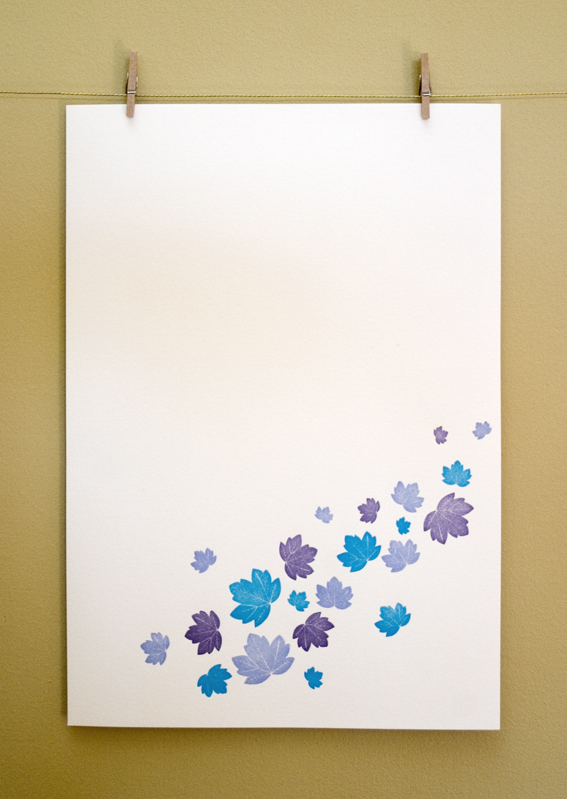
Leaves WIP
I've started printing one of the wedding invitation designs. Three colour, but I've left the text until later, as I have the registration worked out perfectly on the tympan for the leaves. I'm still using the small base that I had made for the Adana, because I'm not convinced that the larger one is completely flat.
Here's a sneak preview of the design so far (excuse the poor photography today):
Friday, April 25, 2008
Back soon
Don't worry, I haven't been neglecting my blog. I've had the flu for the past couple of weeks so everything has gone on hold. Should be back in just a few days!
In the meantime, my new wedding invitation plates have arrived and I'll be printing those shortly. I'm also working on a couple of Mother's Day gifts, which I'll post photos of when they're completed.
In the meantime, my new wedding invitation plates have arrived and I'll be printing those shortly. I'm also working on a couple of Mother's Day gifts, which I'll post photos of when they're completed.
Sunday, April 20, 2008
Letterpress book reviews
If you're interested in learning a bit more about letterpress but can't get hands-on lessons, here are three books that I've found helpful:

Letterpress: New applications for traditional skills
Jury, David.
The title of this book is a bit misleading - I was expecting to find a book that acknowledges the traditional skills of letterpress printing, and then discusses modern letterpress and boutique studio work. Instead, the book is a bit more of a comprehensive history lesson. There's a one-page reference to photopolymer plates, but the author focuses primarily on traditional typography. It's a great book if you want to learn more about the history of the craft of letterpress and is full of great images.
Letterpress Printing - A manual for modern fine press printers
Maravelas, Paul.
This book is an excellent learning resource. It clearly explains the principles of setting type, pulling proofs, cleaning type, operating different types of presses, and troubleshooting prints. It also discusses ink, rollers and paper types - all oriented around the private press, which I found very helpful. There's even a chapter on safety. I highly recommend this book if you're starting out in letterpress. It really has everything you need to know.
General Printing
Cleeton, Pitkin, Cornwell.
This book was originally written in 1941 as a student text book, and is split up into 120 units of study. It fully explains the processes of planning, composition, presswork and bindery. Other methods of printing are also covered as an introduction, which I found very helpful as I haven't done much other print work before. Each unit contains numerous illustrations and photos. Following the units in this textbook is an excellent way to learn how to print, and should sit on any letterpress printer's bookshelf.
Jury, David.
The title of this book is a bit misleading - I was expecting to find a book that acknowledges the traditional skills of letterpress printing, and then discusses modern letterpress and boutique studio work. Instead, the book is a bit more of a comprehensive history lesson. There's a one-page reference to photopolymer plates, but the author focuses primarily on traditional typography. It's a great book if you want to learn more about the history of the craft of letterpress and is full of great images.
Letterpress Printing - A manual for modern fine press printers
Maravelas, Paul.
This book is an excellent learning resource. It clearly explains the principles of setting type, pulling proofs, cleaning type, operating different types of presses, and troubleshooting prints. It also discusses ink, rollers and paper types - all oriented around the private press, which I found very helpful. There's even a chapter on safety. I highly recommend this book if you're starting out in letterpress. It really has everything you need to know.
General Printing
Cleeton, Pitkin, Cornwell.
This book was originally written in 1941 as a student text book, and is split up into 120 units of study. It fully explains the processes of planning, composition, presswork and bindery. Other methods of printing are also covered as an introduction, which I found very helpful as I haven't done much other print work before. Each unit contains numerous illustrations and photos. Following the units in this textbook is an excellent way to learn how to print, and should sit on any letterpress printer's bookshelf.
Using stock images
Online stock libraries are a great resource for graphic designers. They open up a world of possibilities and expand the potential of a design. You can purchase stock images under a variety of licenses depending on how you plan to use them. Royalty-free stock images are the most accessible, although even though you can purchase them for your use, they are still available for purchase by other designers.
As a graphic designer, I've used stock images for myriad projects. They're very useful when you have a tight deadline and need a photo to illustrate some editorial, to use as 'filler' in a publication, to create a visually appealing cover for a magazine, to add texture to a background, or to use as website content. The images can be used as the main image in a design, or as supporting images.
Stock libraries are usually photography-based, but often include other forms of images: video, animations, vector illustrations and rasterized jpgs.
The wedding invitation collection that I've developed uses some royalty-free stock vectors that I've purchased for use from an online stock library. Each design started as a sketch concept with a shortlist of colour sets, fonts and images. Once I'd refined the design and selected the best image, I've then purchased the vector and modified it to fit the design.
I wish now that I'd considered stock vectors for my own wedding invites. It took far too long to develop the pattern and the swirl used in the design - time that I could've spent working on other aspects of the wedding planning if I'd used a stock library.
The drawback to using royalty-free vector images is that they're still available for other designers to use. Usually this isn't a problem - designers cover a wide variety of products and mediums. It's rare to see a stock image being used in two completely different products, say, a promotional DVD and a local magazine. It's even more rare to see an image being used in two similar products. However, I was recently informed that I've used a stock vector for one of my wedding designs that was also used by another letterpress printer in one of their wedding designs. The image itself isn't even a typical 'wedding' image, so this was incredibly surprising to me. Although we'd both used the image in different ways (i.e. two original designs using the same resource), I've decided not to print that particular design. Unfortunate, because it was one of my favourites.
The moral of this story is do your homework when you're creating a new design using stock images. Even though both printers had purchased the image and were entitled to use it, it doesn't look good to their clients if it's picked up. So that's something to keep in mind.
As a graphic designer, I've used stock images for myriad projects. They're very useful when you have a tight deadline and need a photo to illustrate some editorial, to use as 'filler' in a publication, to create a visually appealing cover for a magazine, to add texture to a background, or to use as website content. The images can be used as the main image in a design, or as supporting images.
Stock libraries are usually photography-based, but often include other forms of images: video, animations, vector illustrations and rasterized jpgs.
The wedding invitation collection that I've developed uses some royalty-free stock vectors that I've purchased for use from an online stock library. Each design started as a sketch concept with a shortlist of colour sets, fonts and images. Once I'd refined the design and selected the best image, I've then purchased the vector and modified it to fit the design.
I wish now that I'd considered stock vectors for my own wedding invites. It took far too long to develop the pattern and the swirl used in the design - time that I could've spent working on other aspects of the wedding planning if I'd used a stock library.
The drawback to using royalty-free vector images is that they're still available for other designers to use. Usually this isn't a problem - designers cover a wide variety of products and mediums. It's rare to see a stock image being used in two completely different products, say, a promotional DVD and a local magazine. It's even more rare to see an image being used in two similar products. However, I was recently informed that I've used a stock vector for one of my wedding designs that was also used by another letterpress printer in one of their wedding designs. The image itself isn't even a typical 'wedding' image, so this was incredibly surprising to me. Although we'd both used the image in different ways (i.e. two original designs using the same resource), I've decided not to print that particular design. Unfortunate, because it was one of my favourites.
The moral of this story is do your homework when you're creating a new design using stock images. Even though both printers had purchased the image and were entitled to use it, it doesn't look good to their clients if it's picked up. So that's something to keep in mind.
Tuesday, April 8, 2008
Website design

Here's a sneak preview of the new Poppy Letterpress website. It still needs a bit of tweaking, but it's almost there now.
I'm also hoping to develop a Poppy Newsletter which you can subscribe to, to get monthly updates on the happenings of Poppy Letterpress. It will feature new designs, new products, special offers, and showcase new weddings and beautiful brides that pass our way.
Subscribe to:
Posts (Atom)


